.jpeg)
Ecology and distribution in Poland
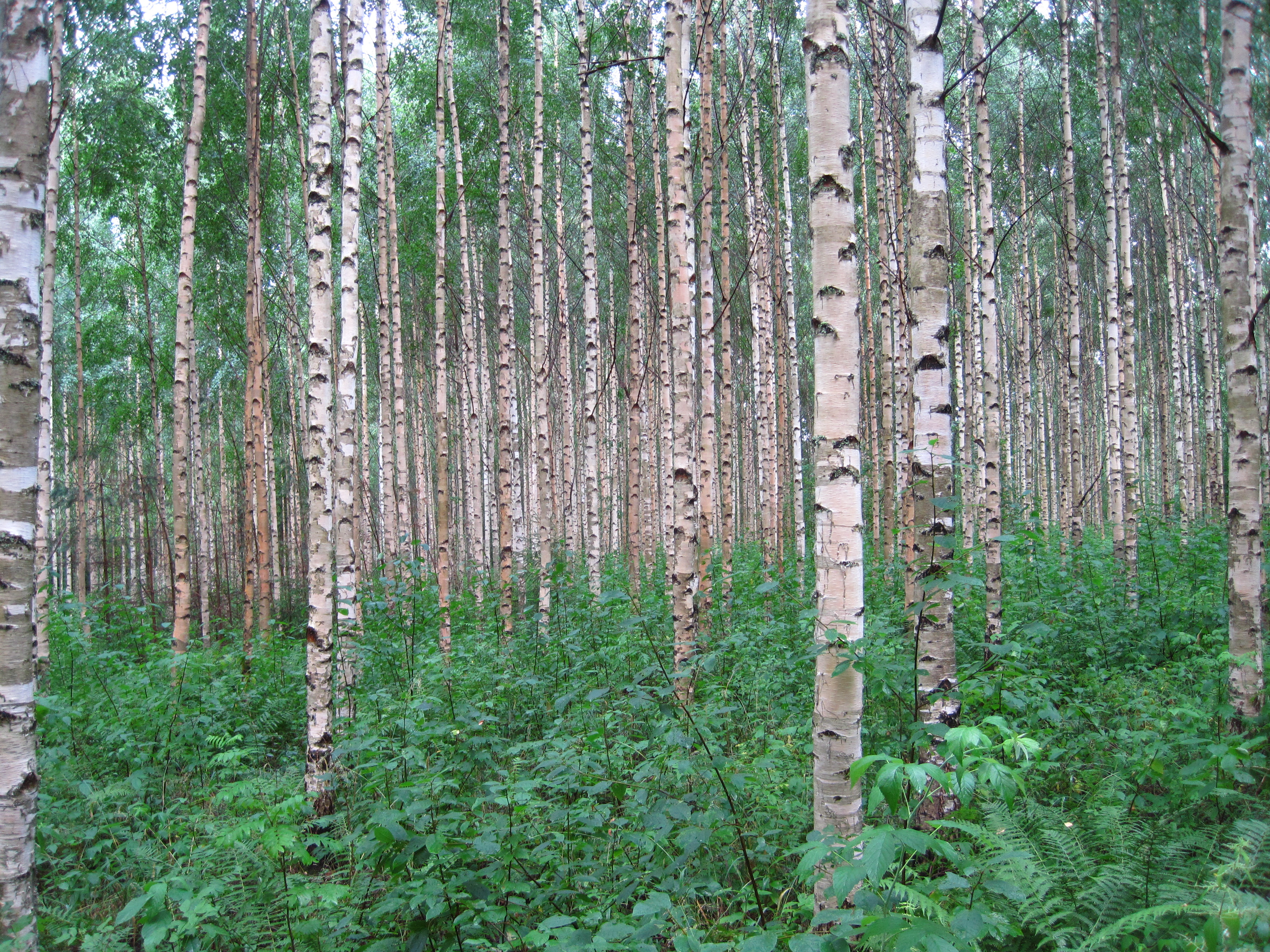
Betula pendula thrives across Poland's varied lowland and upland terrain. It is particularly prevalent on the sandy soils of Mazovia, Warmia-Masuria, and the Podlaskie region, where it colonises cleared land, burned areas, and agricultural fallows. In Poland's largest forest complex, the Białowieża Primeval Forest, birch occupies transitional zones between alder-dominated wetlands and drier mixed-forest zones.
Birch's shade intolerance means it requires open conditions to establish. In managed stands, competing shrubs and grasses are typically removed during the first growing season. On wetter soils, downy birch (Betula pubescens) may dominate instead; field identification relies on leaf shape and bark texture.
Site preparation
Before establishing a new birch stand, soil preparation depends on the previous land use. On former agricultural land, deep ploughing or disc harrowing breaks surface compaction and reduces weed competition. In state forest practice, natural regeneration from seed is preferred where a parent stand exists nearby, reducing the cost of nursery stock.
Birch seed is produced in large quantities and dispersed by wind in late summer and autumn. Germination requires mineral soil contact — dense grass or leaf litter significantly reduces establishment rates. For this reason, scarification of soil patches within clearfells aids natural regeneration where active seeding is impractical.
Thinning schedules
Birch grows rapidly in its first decade, and unmanaged stands quickly become overcrowded. Crown competition reduces stem diameter growth, increases the risk of windthrow, and makes individual trees more vulnerable to bronze birch borer (Agrilus anxius) and other stem-boring insects — though the latter is less prevalent in Poland than in North America.
The thinning regime recommended within Polish state forestry typically follows these broad stages:
- Age 5–10 years: First cleaning — removal of damaged, forked, or suppressed stems to improve spacing. Target spacing approximately 2–3 metres between retained trees.
- Age 15–20 years: First commercial thinning, yielding small-diameter round wood used for fuel or pulp. Stand density reduced to around 800–1,000 stems per hectare.
- Age 25–35 years: Second commercial thinning, targeting the poorest-form trees. Final crop density approaches 300–400 stems per hectare for quality timber production.
Specific rotation lengths and thinning intensities are set out in the management plans (plany urządzenia lasu) prepared for each forest district and approved by the relevant Regional Directorate of State Forests.
Pruning and crown management
Pruning of birch is practised primarily for quality timber production — removing lower branches to produce a clear, knot-free bole. Birch wounds compartmentalise reasonably well, but large-diameter branches (above roughly 3 cm) are best removed at an early stage when wounds seal more quickly.
Pruning should be carried out in winter or early spring before bud break, or in mid-summer after the main flush of sap movement. Cutting in late February or March — when sap pressure rises significantly — results in heavy sap bleeding that weakens the tree without causing permanent harm but is considered poor practice.
Birch bleeds sap heavily if pruned as buds begin to swell. The tree recovers, but repeated pruning during this period stresses young trees unnecessarily.
Pests and disease in Polish birch stands
The principal threats to birch health in Poland include:
- Marssonina betulae — a fungal pathogen causing leaf spot and premature leaf drop, particularly in wet summers. No control is typically applied in productive stands; it rarely causes lasting damage to established trees.
- Birch polypore (Fomitopsis betulina) — a bracket fungus found on weakened or dying birch. Its presence on a live tree indicates advanced heartwood decay; affected trees are removed during thinning for safety reasons.
- Rusty tussock moth (Orgyia antiqua) — a defoliating moth whose caterpillars feed on birch and several other broadleaves. Outbreaks in Poland are localised and typically self-limiting within two or three seasons.
Natural regeneration
Where a parent stand is healthy and productive, Polish forestry practice favours natural regeneration over planting. Birch produces abundant seed from trees aged around 10–15 years, with seed viability declining sharply after a few weeks. Successful seedbed conditions require exposed mineral soil and adequate light — conditions created naturally by clearfelling or heavy thinning.
In mixed-species stands, birch seedlings must be protected from deer browsing during their first few years. Tube shelters or fencing are used where deer pressure is high, particularly in voivodeships with dense populations of roe deer (Capreolus capreolus) and red deer (Cervus elaphus).
References and further reading
- Lasy Państwowe (Polish State Forests) — lasy.gov.pl
- GDOŚ — General Directorate for Environmental Protection
- Bernadzki, E. (2000). Hodowla lasu. Polskie Towarzystwo Leśne, Warszawa.